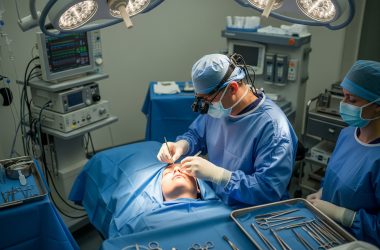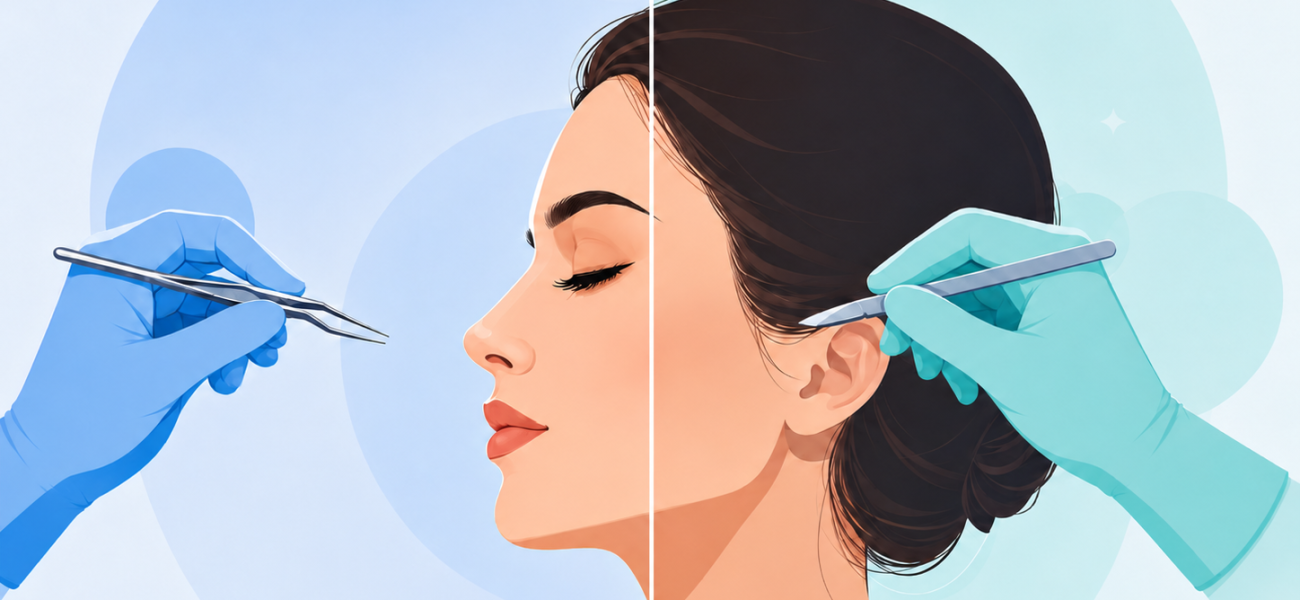


Open rhinoplasty and closed rhinoplasty are two surgical approaches used to reshape the nose. The main difference is where the incisions are made and how the surgeon accesses the nasal bone and cartilage.
Neither approach is automatically better. The appropriate technique is based on nasal anatomy, the planned changes, breathing function, previous surgery, and the surgeon’s assessment.
Open vs Closed Rhinoplasty at a Glance
| Feature | Open Rhinoplasty | Closed Rhinoplasty |
|---|---|---|
| Incisions | Inside the nose and across the tissue between the nostrils | Inside the nostrils |
| External scar | A small scar may be present | No external incision |
| Surgical access | More direct visibility of nasal structures | More limited direct visibility |
| Common use | Complex reshaping, major tip work, revision cases | Selected cases requiring less extensive access |
| Swelling | Tip swelling may take longer to settle | May involve less early swelling in some cases |
| Surgery time | May be longer in complex cases | May be shorter in selected cases |
| Recovery | Early recovery is broadly similar | Early recovery is broadly similar |
| Final choice | Based on anatomy and surgical plan | Based on anatomy and surgical plan |
The NHS explains that open rhinoplasty uses an incision across the skin between the nostrils, while closed rhinoplasty uses incisions inside the nostrils. It also notes that closed rhinoplasty leaves no visible external scar but is not possible or available for every case.
What Is Open Rhinoplasty?
Open rhinoplasty uses a small incision across the columella, the strip of tissue between the nostrils. Additional incisions are made inside the nose.
Through these incisions, the nasal skin is carefully lifted so that the surgeon can access the underlying bone and cartilage more directly. The American Society of Plastic Surgeons describes open rhinoplasty as an approach using an incision across the columella, while the closed approach keeps the incisions inside the nose.
Open rhinoplasty may be considered when treatment involves:
- Significant nasal tip reshaping
- Major asymmetry
- Complex cartilage work
- Structural reconstruction
- Previous nasal surgery
- Nasal trauma
- Combined cosmetic and breathing-related changes
- The need for cartilage grafts
The main advantage is increased visibility and access. The main trade-offs are the external incision and the possibility of longer-lasting swelling around the nasal tip.
What Is Closed Rhinoplasty?
Closed rhinoplasty, sometimes called endonasal rhinoplasty, uses incisions made entirely inside the nostrils.
Because there is no incision across the columella, there is no visible external scar from the surgical approach. However, the surgeon works through a more restricted access route.
Closed rhinoplasty may be considered for selected cases involving:
- Nasal bridge reshaping
- Removal or reduction of a nasal hump
- Smaller changes to the nasal tip
- Mild to moderate cosmetic changes
- Cases that do not require extensive structural reconstruction
The absence of an external incision does not mean the surgery is minor or risk-free. Closed rhinoplasty still involves reshaping nasal structures and requires careful planning.
Main Difference 1: Incision Placement
The clearest difference is where the incisions are made.
In open rhinoplasty, a small external incision is made between the nostrils. In closed rhinoplasty, the incisions remain inside the nose.
| Approach | Incision Location |
|---|---|
| Open rhinoplasty | Inside the nostrils and across the columella |
| Closed rhinoplasty | Entirely inside the nostrils |
Patients often focus on the possibility of a visible scar. However, incision placement is only one part of the decision. The surgeon also needs enough access to make the planned structural changes safely.
Main Difference 2: Surgical Visibility
Open rhinoplasty gives the surgeon more direct visibility of the nasal framework. This may make it easier to assess asymmetry, reshape the tip, place grafts, or reconstruct weakened structures.
Closed rhinoplasty provides less direct exposure. It may still be effective when the required changes can be completed through internal incisions.
The choice is therefore not simply between “more invasive” and “less invasive.” It is a choice between two access methods, each suited to different surgical plans.
Main Difference 3: Scarring
Closed rhinoplasty does not create an external columella incision.
Open rhinoplasty creates a small scar between the nostrils. This scar often becomes less noticeable as it heals, but scar appearance varies according to skin type, healing response, surgical technique, and aftercare.
Patients with a history of raised or difficult scars should mention this during their consultation.
Main Difference 4: Swelling
Swelling can occur after both approaches.
Open rhinoplasty may involve longer-lasting swelling around the nasal tip because more tissue is lifted during surgery. Closed rhinoplasty may produce less early swelling in selected cases, but this should not be treated as a guarantee.
The amount and duration of swelling can also be affected by:
- Skin thickness
- The amount of bone and cartilage work
- Tip reshaping
- Previous nasal surgery
- Healing response
- Whether grafts are used
- Post-operative care
A future rhinoplasty swelling timeline article could explain why swelling changes gradually and why the nasal tip often takes longer to settle than the bridge.
Main Difference 5: Type of Correction
Open rhinoplasty is often discussed for more complex structural changes. Closed rhinoplasty may be suitable when the treatment plan requires more limited access.
Open rhinoplasty may be considered for:
- Major tip reconstruction
- Significant asymmetry
- Complex cartilage grafting
- Severe structural problems
- Revision rhinoplasty
- Correction after trauma
Closed rhinoplasty may be considered for:
- Selected bridge changes
- Smaller hump reduction
- Limited tip reshaping
- Cases without extensive reconstruction
- Patients whose anatomy allows internal access
These are general patterns rather than fixed rules. Experienced surgeons may use different approaches according to their training and the individual case.
Cosmetic and Functional Changes
Rhinoplasty can address appearance, breathing-related structural concerns, or both.
When nasal reshaping is combined with correction of internal structures affecting breathing, septorhinoplasty may be discussed. When the main concern is a deviated septum rather than external appearance, septoplasty may be more relevant.
The American Society of Plastic Surgeons notes that rhinoplasty can improve facial proportions and may also address impaired breathing caused by structural defects.
Patients with breathing concerns may benefit from a consultation with an otolaryngologist as part of their evaluation.
Benefits of Open Rhinoplasty
Possible benefits of open rhinoplasty include:
- More direct access to bone and cartilage
- Better visibility during complex restructuring
- Greater access for tip work
- Easier placement of some cartilage grafts
- Usefulness in selected revision cases
- More direct assessment of structural asymmetry
Possible limitations include:
- A small external scar
- Potentially longer tip swelling
- More tissue lifting
- A potentially longer operation in complex cases
Benefits of Closed Rhinoplasty
Possible benefits of closed rhinoplasty include:
- No external incision
- No visible columella scar from the approach
- Less tissue lifting in selected cases
- Potentially shorter surgery in some cases
- Possibly less early swelling in appropriate patients
Possible limitations include:
- More restricted access
- Less direct visibility of the nasal framework
- Reduced suitability for some complex corrections
- Greater technical difficulty for certain structural changes
Neither list means one method produces better results. The result is shaped by case selection, planning, surgical execution, healing, and realistic expectations.
Which Approach Produces Better Results?
There is no general rule that open or closed rhinoplasty produces better results.
Important factors include:
- Nasal anatomy
- Skin thickness
- Strength of the cartilage
- Facial proportions
- Breathing function
- Previous surgery
- The planned amount of change
- Surgeon experience with the selected technique
- The patient’s healing response
Patients should be cautious about claims that one approach is always superior or always heals faster.
A future guide on how to choose a rhinoplasty surgeon abroad could help international patients evaluate qualifications, experience, before-and-after photographs, communication, complication policies, and follow-up arrangements.
How Long Does the Surgery Take?
Rhinoplasty commonly takes approximately 1.5 to 3 hours, although more complex or revision procedures may take longer. The operation may be completed using either an open or closed approach.
The procedure is commonly performed under general anesthesia, although the anesthesia plan should be confirmed with the treating surgical and anesthesia teams.
Surgery time should not be used as the main measure of quality. A shorter procedure is not automatically safer or better.
Recovery After Open and Closed Rhinoplasty
Early recovery is broadly similar for both approaches.
Patients may experience:
- Swelling
- Bruising around the eyes
- Nasal congestion
- Tenderness
- Light bleeding
- Temporary numbness
- Difficulty breathing through the nose
- A splint or dressing over the nose
A general rhinoplasty recovery timeline may look like this:
| Time After Surgery | General Expectations |
|---|---|
| First 1–3 days | Swelling, congestion, bruising, and rest |
| Around 1 week | Splint assessment or removal |
| 1–2 weeks | Many patients return to light daily activities |
| 3–6 weeks | Gradual return to more demanding activities when cleared |
| Several months | Swelling continues to decrease |
| Up to 12 months or longer | Nasal shape continues to refine |
The NHS notes that patients may need up to two weeks away from work, while swelling can take several months to resolve. The American Society of Plastic Surgeons states that the nasal contour may continue refining for up to a year.
Patients should ask their surgeon about dressings, medication, activity limits, exercise, stitch removal, and follow-up appointments.
This is general information and not medical advice.
Is Recovery Faster with Closed Rhinoplasty?
Closed rhinoplasty may have a shorter early recovery in selected cases because there is no external incision and less tissue may be lifted.
However, recovery is also influenced by the amount of reshaping performed. A complex closed procedure may involve more swelling or discomfort than a limited open procedure.
Patients should compare the planned operation, not only the name of the approach.
Possible Risks
Open and closed rhinoplasty share many of the same surgical risks.
Possible risks can include:
- Bleeding
- Infection
- Anesthesia-related complications
- Breathing difficulty
- Changes in skin sensation
- Poor wound healing
- Asymmetry
- Persistent swelling
- Scarring
- Septal perforation
- Unsatisfactory appearance
- Need for revision surgery
The American Society of Plastic Surgeons identifies risks including infection, breathing difficulty, altered sensation, poor healing, septal perforation, swelling, dissatisfaction with appearance, and possible revision surgery.
A future article about rhinoplasty risks and revision planning could explain the questions patients should ask about complications, corrective treatment, revision timing, and long-term follow-up.
No surgical provider should guarantee perfect symmetry or a specific cosmetic result.
Considerations for International Patients
International patients should plan for consultation, surgery, early recovery, splint removal, and follow-up before returning home. For a broader overview of the procedure, preparation, recovery, and important considerations when travelling for treatment, read our Rhinoplasty Surgery Guide.
Important questions include:
- How long should I remain in the country?
- When will the splint be removed?
- Will stitches need to be removed?
- When can I fly home?
- Who should I contact after returning home?
- Will follow-up be remote or in person?
- What happens if a complication develops?
- What medical documents will I receive?
- What is the revision policy?
A plastic surgery consultation should explain why an open or closed approach is recommended and what changes are realistically expected.
Patients travelling to Türkiye should also verify that the healthcare provider and any intermediary organization hold the required International Health Tourism Authorization Certificate. HealthTürkiye states that facilities and intermediaries offering international medical tourism services must receive this authorization.
Questions to Ask Before Choosing
Before agreeing to open or closed rhinoplasty, patients can ask:
- Which approach is recommended, and why?
- Where will the incisions be placed?
- Will breathing function be assessed?
- Is the procedure cosmetic, functional, or both?
- Is cartilage grafting expected?
- How much swelling is typical for the planned procedure?
- How long should I stay before travelling home?
- When will the splint be removed?
- What is included in the quote?
- How will follow-up work after I return home?
- What happens if revision surgery is needed?
- Which medical records will be provided?
Clear explanations are more useful than claims that one technique is universally better.
Final Thoughts
Open and closed rhinoplasty are different methods of accessing the nasal framework. Open rhinoplasty provides more direct visibility and may be considered for complex restructuring, tip work, or revision surgery. Closed rhinoplasty keeps the incisions inside the nose and may be suitable for selected cases requiring less extensive access.
The appropriate approach should be based on anatomy, breathing function, previous surgery, treatment goals, and professional assessment.
MedicaRoute can help patients compare itemized rhinoplasty plans and understand what is included before travelling. The aim should be to understand the complete surgical and follow-up plan rather than choosing an approach only because it appears more popular or promises a faster recovery.