
A fuller male chest does not always mean gynecomastia.
Two different conditions can create a similar appearance: true gynecomastia, which involves enlargement of glandular breast tissue, and excess chest fat, often called pseudogynecomastia. Some men have a combination of both.
The distinction matters because the appropriate treatment can be very different. Weight loss may reduce a chest that is enlarged mainly because of fat, while established glandular tissue may remain even after significant fat loss. Liposuction can remove excess fat, but it does not remove glandular breast tissue.
For patients considering gynecomastia surgery, identifying what is actually creating the chest fullness is therefore the first step.
What Is Gynecomastia?
Gynecomastia is enlargement of male breast tissue caused by an increase in glandular tissue.
It may affect one or both sides of the chest and can occur during puberty, later adulthood, or in association with certain medications, anabolic steroids, medical conditions, and hormonal changes. The enlarged tissue is commonly concentrated beneath or around the nipple and areola.
Some patients also have excess fat around the chest. This means the appearance may result from a combination of glandular tissue and fatty tissue rather than a single cause.
What Is Chest Fat or Pseudogynecomastia?
Pseudogynecomastia describes male chest enlargement caused mainly by fatty tissue rather than enlargement of the breast gland.
It is commonly associated with increased body fat, although every person stores fat differently. Someone can therefore carry noticeable fat around the chest without having true gynecomastia.
Being overweight also does not rule out gynecomastia. A patient can have both excess chest fat and enlarged glandular tissue at the same time.
This distinction becomes especially important when deciding whether weight management, liposuction, gland removal, or a combination of treatments is appropriate.
Gynecomastia vs Chest Fat: What Is the Main Difference?
The main difference is the type of tissue responsible for the enlargement.
| Gynecomastia | Chest Fat / Pseudogynecomastia | |
| Main tissue | Enlarged glandular breast tissue | Excess fatty tissue |
| Typical location | Often concentrated beneath the nipple and areola | Usually more widely distributed across the chest |
| Effect of weight loss | Glandular tissue may remain | Often decreases as overall body fat decreases |
| Liposuction | Can remove associated fat | May be suitable for localized excess fat |
| Gland excision | May be necessary | Usually unnecessary if glandular enlargement is absent |
In real patients, however, the distinction is not always this clear. Fat, glandular tissue and loose skin can all contribute to the final chest shape.
What Does True Gynecomastia Feel Like?
Gynecomastia may feel different from ordinary chest fat.
Glandular tissue can form a firmer, button-like or disc-like area beneath the nipple and areola. Fat generally feels softer and is often distributed more diffusely around the chest. Some patients with gynecomastia also experience tenderness or soreness.
However, trying to diagnose yourself by touching the chest is not reliable.
The consistency and distribution of tissue vary between patients, and many people have both fat and glandular tissue. A proper examination is more reliable than a self-test.
Can You Tell the Difference by Looking in the Mirror?
Appearance can provide clues, but it cannot confirm whether the chest contains enlarged glandular tissue.
Chest fat often creates more general fullness across the chest. Gynecomastia may create a more concentrated projection around the nipple and areola.
There are many exceptions.
A lean man can have prominent gynecomastia. Someone who is overweight can have mainly chest fat, true gynecomastia, or both. Significant weight loss can also leave loose skin that continues to affect the contour.
Photographs can be useful during an initial consultation, but treatment planning should ultimately consider the actual tissue beneath the skin.
Why Does Gynecomastia Develop?
Changes in hormone activity are one of the major reasons glandular breast tissue can enlarge.
Gynecomastia is particularly common during puberty and later life. It can also be associated with certain medications, anabolic steroids, an overactive thyroid, kidney disease, liver disease and other medical conditions. Sometimes no single cause can be identified.
This is one reason medical assessment can be important before cosmetic treatment.
Surgery can change the physical appearance of the chest, but it does not diagnose or treat every possible underlying cause.
Prescription medication should also not be stopped simply because gynecomastia is suspected. Medication changes should be discussed with the clinician responsible for the treatment.
Does Being Overweight Cause Gynecomastia?
Being overweight can make the male chest larger because additional fat may accumulate in the area.
However, excess chest fat and true gynecomastia are not the same condition.
A patient may lose substantial weight and see the fatty component of the chest become smaller while a firm area beneath the nipple remains.
This is why body weight alone cannot determine whether someone has gynecomastia.
Can Weight Loss Get Rid of Gynecomastia?
Weight loss can reduce fatty tissue in the chest.
If chest enlargement is mainly caused by excess fat, losing body fat may significantly improve its appearance.
Established glandular breast tissue behaves differently. Losing weight does not reliably remove the enlarged breast gland itself.
For some patients, weight loss makes the distinction more noticeable: the rest of the chest becomes leaner while a persistent area around the nipple remains.
This does not mean patients need to reach extremely low body-fat levels before seeking advice. Weight, tissue distribution, skin quality and treatment goals should be considered together.
Can Exercise Get Rid of Gynecomastia?
Exercise can strengthen the pectoral muscles and help reduce overall body fat, but it cannot selectively eliminate established glandular breast tissue.
If the chest enlargement is mainly fatty, regular exercise and appropriate nutrition may improve it considerably.
If enlarged glandular tissue remains, developing the pectoral muscles underneath it can alter the shape of the chest but does not directly remove the gland.
For this reason, a physically fit person can still have noticeable gynecomastia.
Can You Have Gynecomastia and Chest Fat at the Same Time?
Yes.
A patient’s chest may contain excess fat, enlarged glandular tissue, loose skin, or a combination of all three.
These different components matter because they are not treated in exactly the same way. The American Society of Plastic Surgeons explains that liposuction may be used when excess fatty tissue is primarily responsible, while excision is used when glandular tissue or excess skin needs to be removed. Some patients require both techniques.
Treating only one component may therefore leave another part of the problem unchanged.
How Is Gynecomastia Diagnosed?
Assessment usually begins with medical history and physical examination.
A healthcare professional may ask when the chest enlargement began, whether it is painful, whether one or both sides are affected, and which medications, supplements or other substances are being used.
The chest tissue is then examined to assess its amount, distribution and consistency.
When necessary, further investigations can be used to identify a possible cause or rule out another condition. Depending on the circumstances, these may include blood tests or breast imaging.
Not every patient requires the same tests.
When Should a Chest Lump Be Checked?
Not every change in the male breast should automatically be assumed to be gynecomastia.
The NHS recommends medical assessment for symptoms such as a breast or nipple lump, persistent pain, nipple discharge or bleeding, and changes in the skin or nipple.
These symptoms do not necessarily indicate a serious condition, but they should be properly assessed before cosmetic treatment is planned.
A new or unusual one-sided lump should not be diagnosed from photographs alone.
When Is Liposuction Enough?
Liposuction can be useful when excess fatty tissue is the main cause of the chest enlargement.
During the procedure, a thin cannula is inserted through small incisions and used to remove fat from the chest. The aim is to reduce excess volume and improve the contour.
However, liposuction removes fat rather than glandular breast tissue. If a significant gland is present underneath the nipple, liposuction alone may not adequately correct the projection.
This is one of the most important questions to clarify when comparing surgical plans.
When Is Gland Excision Needed?
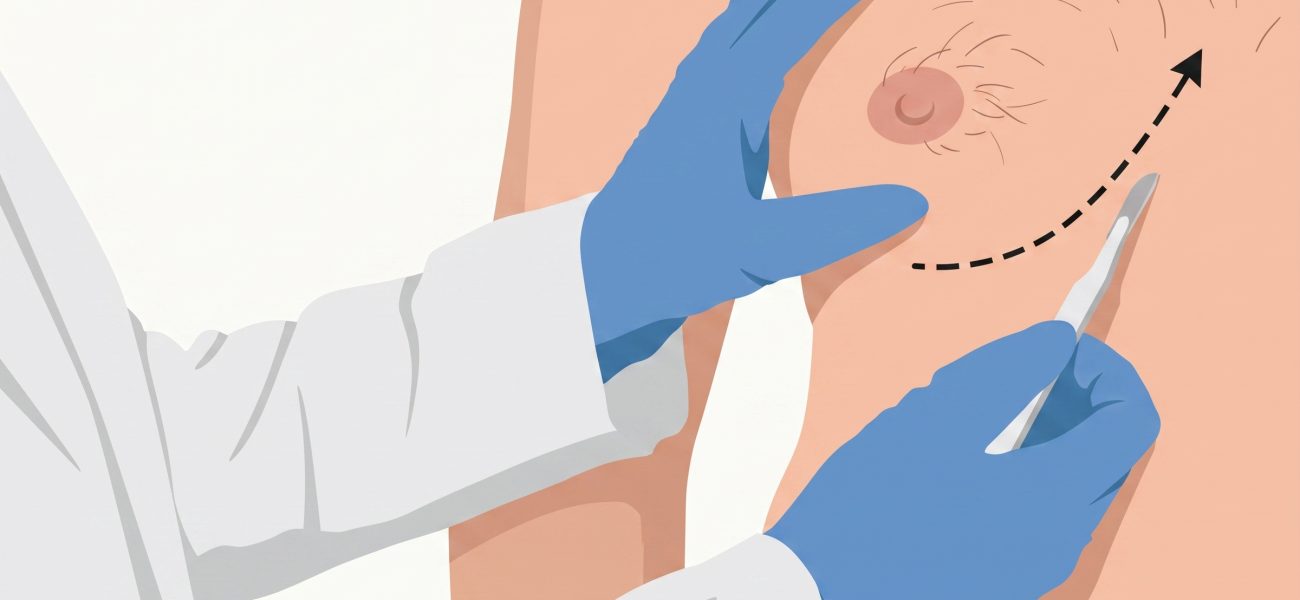
Excision is used when enlarged glandular breast tissue needs to be physically removed.
The tissue can often be accessed through an incision positioned around part of the areola. The extent and position of the incision vary according to the amount of glandular tissue, skin excess and the surgeon’s planned technique.
Excision may also be necessary when the areola needs to be reduced or the nipple position needs to be changed.
For patients with true gynecomastia, the procedure can therefore involve considerably more than simply removing chest fat. For a detailed overview of the procedure, costs, and recovery expectations, read our Gynecomastia Surgery in Turkey guide.
When Are Liposuction and Gland Excision Combined?
Many patients have both fatty and glandular components.
In these cases, liposuction can be used to reduce excess fat and contour the surrounding chest, while excision removes the denser glandular tissue beneath the nipple.
The combination allows the surgeon to address different types of tissue during the same treatment.
The objective is not simply to remove the maximum amount possible. Excessive removal can also create depressions or contour irregularities.
A balanced chest contour is the goal.
Recovery can vary depending on whether liposuction, gland excision, or both techniques are used. For more information about swelling, compression garments, and returning to exercise, read our Gynecomastia Recovery Timeline guide.
What About Loose Skin?
Skin quality is another part of treatment planning.
After relatively mild gynecomastia is corrected, good-quality skin may contract around the new chest contour.
Patients with more severe enlargement, major previous weight loss or substantial skin laxity may have excess skin that cannot be corrected by liposuction alone.
In more advanced cases, additional skin removal and repositioning of the nipple-areola complex may be considered. This can require larger incisions and therefore longer scars.
This is why a plastic surgery plan should consider fat, glandular tissue and skin together rather than focusing on a single technique.
Can Gynecomastia Go Away Without Surgery?
Yes, depending on the cause and age of the patient.
Gynecomastia that develops during puberty often improves naturally over time. If another health condition or medication contributes to the enlargement, addressing that factor may also help when medically appropriate.
Weight reduction can improve the fatty component of the chest.
Surgery is more commonly considered when persistent enlargement remains after appropriate evaluation and continues to cause physical discomfort or concern about appearance.
Which Treatment Is Needed?
The answer depends on what is creating the chest enlargement.
If the problem is mainly excess body fat, weight management may be the appropriate first step.
If localized chest fat remains despite a stable weight, liposuction may be considered in selected patients.
If significant glandular breast tissue is responsible for the projection, gland excision may be necessary.
When both gland and fat are present, liposuction and excision may be combined. Significant loose skin can require additional skin removal.
The MedicaRoute gynecomastia surgery page similarly describes treatment as potentially involving liposuction, excision, or a combination according to the individual case.
Why the Correct Diagnosis Matters Before Treatment Abroad
Two patients can have similar-looking chests but require very different procedures.
One may primarily have excess fat.
Another may have a firm gland beneath the nipple.
A third may have fat, glandular tissue and loose skin together.
For international patients, this distinction is particularly important because a preliminary quotation may be prepared before an in-person examination.
A useful treatment plan should therefore explain whether the proposed procedure includes liposuction, gland excision, skin removal, or a combination rather than simply listing “gynecomastia surgery.”
Patients comparing options through MedicaRoute can request a personalized Treatment Plan / Quote based on their individual case.
The Bottom Line
Gynecomastia and excess chest fat can create a similar appearance, but they involve different types of tissue.
True gynecomastia involves enlarged glandular breast tissue. Pseudogynecomastia is primarily related to fatty tissue. Many patients have a combination of both.
Weight loss and exercise can help reduce chest fat but cannot reliably eliminate established glandular tissue. Liposuction removes fat, while glandular tissue may require direct excision. Some patients need both approaches.
The most useful question is therefore not simply whether the chest looks enlarged.
It is whether the enlargement comes from fat, glandular tissue, loose skin, or a combination of these factors. Once that is established, choosing the appropriate treatment becomes much clearer.