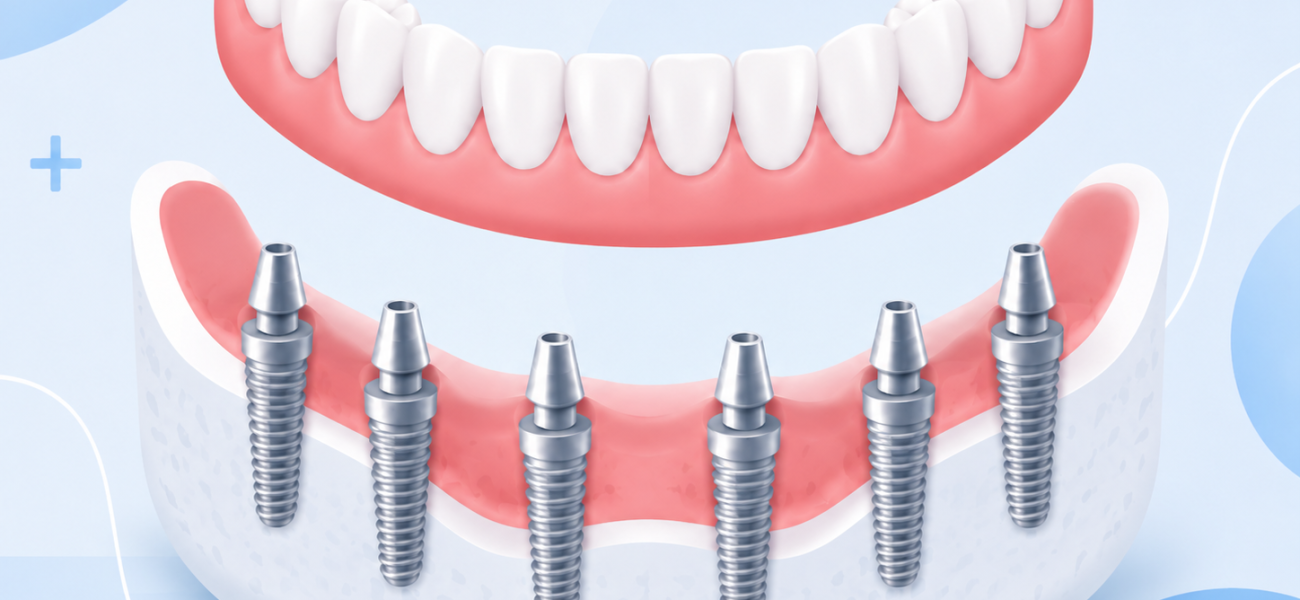
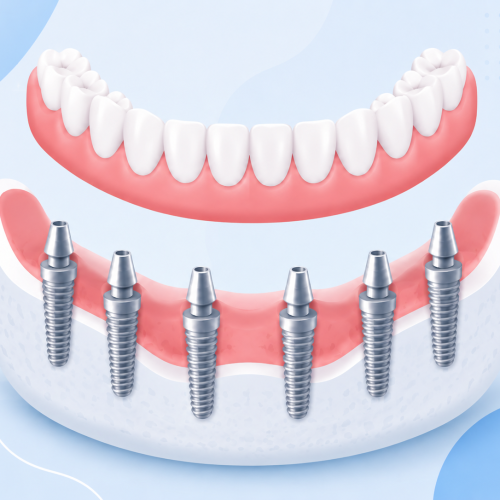

All-on-6 dental implants use six implants to support a fixed set of replacement teeth across one complete dental arch.
For international patients, the main considerations are not only price. The number of visits, temporary and final teeth, bone requirements, travel planning, recovery, and follow-up care should all be clarified before treatment begins.
All-on-6 Dental Implants at a Glance
| Topic | General Information |
| Main purpose | Complete upper or lower arch replacement |
| Number of implants | Six implants per jaw |
| Typical cost in Turkey | Around €3,500–€6,500 per jaw |
| First stay in Turkey | Commonly around 5–7 days |
| Procedure duration | Commonly around 2–4 hours |
| Healing period | Usually around 3–6 months |
| Number of visits | Often two treatment stages |
| Final teeth | Usually fitted after implant healing |
Current MedicaRoute listing data gives a typical All-on-6 package range of approximately €3,500–€6,500, a first stay of around 5–7 days, and a final-result timeline of approximately 3–6 months.
What Is All-on-6 Treatment?
All-on-6 is a full-arch implant treatment. Six dental implants are placed in the jawbone to support a connected fixed prosthesis.
Dental implants are screw-shaped components placed in the jawbone to support replacement crowns, bridges, or dentures. The treatment normally includes a surgical phase followed by a restorative phase after the implants have healed.
All-on-6 may be evaluated for patients who:
- Have lost most or all teeth in one jaw
- Have several severely damaged or failing teeth
- Use uncomfortable or unstable dentures
- Want fixed rather than removable replacement teeth
- Have enough suitable bone for six implant positions
- Can attend both surgical and restorative appointments
A dental examination and imaging are needed before suitability can be assessed. Bone volume, gum health, active infections, general health, smoking, bite forces, and long-term cleaning all matter.
Why Do International Patients Consider All-on-6?
International patients commonly compare All-on-6 treatment abroad because full-arch implant costs may be lower and treatment can often be organized within planned travel periods.
However, the headline price should not be the only deciding factor. Patients should also review:
- The implant system
- The qualifications of the treating professionals
- Temporary and final prosthetic materials
- The expected number of visits
- Follow-up arrangements
- Possible extra procedures
- What happens if an implant or prosthesis develops a problem
How Much Does All-on-6 Cost?
In Turkey, All-on-6 treatment commonly costs around €3,500–€6,500 per jaw. The current MedicaRoute treatment page lists a starting price of approximately €3,800 and an average package range of €3,500–€6,500.
For both jaws, the total may be around €7,000–€13,000 or more, depending on what is included.
| Cost Item | Possible Pricing |
| All-on-6 for one jaw | €3,500–€6,500 |
| All-on-6 for both jaws | €7,000–€13,000+ |
| Extractions | Included or charged separately |
| Bone grafting | Additional if required |
| Temporary teeth | Included in some packages |
| Final prosthesis | Included or separate |
| Hotel and transfer | Package-dependent |
| Second visit | May not be included |
Two packages with similar prices may include different services. One may include temporary and final teeth, while another may cover only implants and the temporary restoration.
What Should an All-on-6 Quote Include?
Before booking, patients should request an itemized quote showing:
- Consultation
- X-rays and 3D imaging
- Tooth extractions
- Six implants per jaw
- Implant abutments and components
- Temporary fixed teeth
- Final prosthesis
- Prosthetic material
- Medication
- Follow-up appointments
- Implant documentation
- Hotel accommodation
- Airport and facility transfers
- Translation support
- Second-visit costs
- Warranty or revision terms, if offered
The quote should also identify which services are excluded.
All-on-6 Treatment Process
1. Preliminary Medical and Dental Review
Before travelling, patients may be asked to provide:
- Dental photographs
- Recent X-rays
- Medical history
- Current medication list
- Previous implant or dental records
- Information about smoking
- Details of existing medical conditions
This review may help prepare a preliminary plan, but it does not replace an in-person examination.
2. Consultation and Imaging
After arrival, a consultation with a dentist is used to assess the teeth, gums, bite, and oral condition.
A 3D dental scan may be used to evaluate the amount and position of available bone, as well as nearby nerves and sinuses. Public hospital guidance notes that CT imaging may be recommended because it provides three-dimensional information for implant planning.
3. Removal of Failing Teeth
Teeth that cannot be retained may need to be removed. A surgical tooth extraction may be completed before implant placement or during the same treatment stage.
The timing is decided after examination and imaging.
4. Placement of Six Implants
Six implants are placed in the upper or lower jaw according to the surgical plan.
The MedicaRoute All-on-6 page lists a typical procedure duration of approximately 2–4 hours and local anesthesia as the common anesthesia type. Actual timing can change with extractions, grafting, and treatment of both jaws.
5. Temporary Fixed Teeth
Temporary teeth may be attached shortly after implant placement if the implant stability and treatment plan allow it.
Immediate-load All-on-6 dental implants may allow a temporary fixed restoration to be fitted on the same day or soon after surgery. This does not normally mean that the final permanent prosthesis is complete.
Understanding immediate-load implants vs conventional implant loading can help patients ask clearer questions about temporary teeth and healing.
6. Healing Period
The implants are then left to bond with the jawbone through osseointegration.
Implant healing commonly takes around 3–6 months. Bone grafting can extend the treatment period, and implant outcomes are influenced by bone quality, gum health, smoking, and oral hygiene.
7. Placement of the Final Prosthesis
After healing, new impressions or digital scans are taken for the final prosthesis.
The temporary teeth are removed and the final restoration is fitted and adjusted. International patients may need to return for a second visit.
Temporary Teeth vs Final Teeth
This distinction is one of the most important parts of full-arch treatment.
Temporary teeth are designed for the healing period. They may have limitations on chewing pressure, material strength, and long-term appearance.
Final teeth are fitted after the implants have integrated with the jawbone. The final prosthesis may use:
- Acrylic
- Composite
- Zirconia
- Metal-reinforced hybrid materials
Patients should ask:
- Are both temporary and final teeth included?
- What material will each restoration use?
- Is the final prosthesis made during a second visit?
- What happens if temporary teeth fracture?
- Are future repairs available in the home country?
Is Bone Grafting Always Needed?
No. Bone grafting is not automatically required for every All-on-6 patient.
However, six implant sites need enough appropriate bone. When bone volume is inadequate, grafting or a different implant arrangement may be discussed.
Public hospital guidance notes that implant patients require adequate bone height and volume, and grafting may extend treatment by several months.
The need for grafting cannot be confirmed reliably from photographs alone.
All-on-6 vs All-on-4
The main difference is the number of implants.
All-on-4 dental implants use four implants per jaw. All-on-6 uses six.
Six implants may provide additional support points, but they also require suitable bone at more implant locations. Four implants may be more practical in selected cases with limited bone or a lower treatment budget.
Neither option is automatically better. The choice should reflect bone condition, anatomy, bite forces, prosthetic design, and the full treatment plan.
A detailed comparison is available in All-on-4 vs All-on-6 Dental Implants.
How Long Should International Patients Stay?
Many patients plan approximately 5–7 days for the first treatment visit. This may cover consultation, imaging, extractions, implant placement, temporary teeth, and early follow-up.
A practical timeline may look like this:
| Stage | Approximate Timing |
| First consultation and imaging | Day 1 |
| Implant surgery | Early in the visit |
| Temporary teeth and adjustment | During the first visit |
| Early follow-up | Before departure |
| Healing at home | 3–6 months |
| Second visit for final teeth | Several days |
Travel dates should remain flexible in case the treatment plan changes after the in-person examination.
Recovery and Aftercare
After implant surgery, patients may experience soreness, swelling, bruising, and minor bleeding. Discomfort commonly improves within about one week.
A general recovery pattern may include:
| Time After Surgery | General Expectations |
| First 24–48 hours | Swelling, tenderness, minor bleeding, and rest |
| First week | Soft foods and careful oral hygiene |
| 1–2 weeks | Early follow-up and gradual improvement |
| 3–6 months | Implant integration |
| After healing | Final prosthesis stage |
Patients should follow the written instructions given by their treating team. This article provides general information and is not medical advice.
Possible Risks
All-on-6 involves dental surgery and may carry risks such as:
- Pain and swelling
- Bleeding
- Infection
- Implant failure
- Altered sensation
- Sinus complications in the upper jaw
- Prosthesis loosening or fracture
- Bite problems
- Need for further treatment
Implant success is affected by bone quality, gum health, smoking, oral hygiene, and regular maintenance. Some implants may fail to bond with the bone and may need to be removed.
A future article about dental implant failure signs and causes could provide a more detailed overview.
Who Should Think Carefully Before Travelling?
Treatment abroad may not be practical for every patient.
Local evaluation may be more appropriate when:
- There is an urgent infection
- A medical condition affecting healing is not controlled
- The patient needs close ongoing medical care
- The patient cannot remain for early follow-up
- A second visit for the final teeth is not possible
- Follow-up care at home has not been arranged
- The quote does not include the final prosthesis
- The provider guarantees success
Patients should discuss their individual situation with licensed dental and medical professionals.
How to Check a Provider in Turkey
International patients should confirm that the healthcare facility and any intermediary organization are authorized for international health tourism.
Turkey requires facilities and intermediaries offering international medical tourism services to hold an International Health Tourism Authorization Certificate. The Ministry of Health publishes lists of authorized providers.
Authorization is an important administrative check, but it does not guarantee a particular clinical outcome.
Questions International Patients Should Ask
Before booking, ask:
- Why are six implants being recommended?
- Is the treatment for one jaw or both?
- Which implant system will be used?
- Will I receive implant documentation?
- Are extractions included?
- Is bone grafting expected?
- Are temporary teeth included?
- Are final teeth included?
- What material will the final prosthesis use?
- How many visits are required?
- How long should I remain in Turkey?
- What happens if an implant fails?
- How will follow-up work after I return home?
- Which costs are not included?
Clear answers are more useful than a low package price without detail.
Final Thoughts
All-on-6 dental implants can provide fixed full-arch replacement teeth for patients with extensive tooth loss. For international patients, the key issues are treatment suitability, total cost, temporary and final teeth, the number of visits, recovery, and long-term maintenance.
MedicaRoute can help patients compare itemized All-on-6 plans and understand what is included before making travel arrangements.