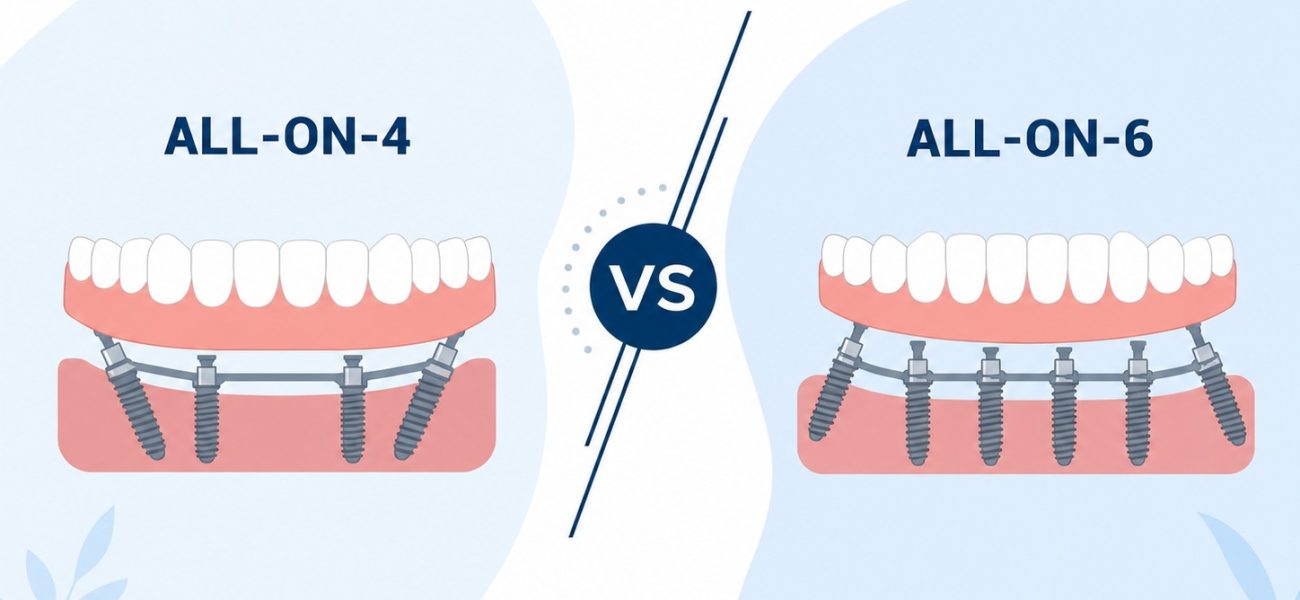

All-on-4 and All-on-6 are full-arch dental implant treatments used to replace a complete set of missing or failing teeth. The main difference is simple: All-on-4 uses four implants per jaw, while All-on-6 uses six implants per jaw.
Both options can support fixed teeth, but they can differ in cost, implant distribution, stability, bone requirements, treatment planning, and long-term maintenance.
Quick Comparison
| Feature | All-on-4 | All-on-6 |
| Number of implants | 4 implants per jaw | 6 implants per jaw |
| Main use | Full-arch tooth replacement | Full-arch tooth replacement |
| Cost | Usually lower | Usually higher |
| Implant support | Fewer support points | More support points |
| Bone requirement | May need less available bone in some cases | May need more suitable bone |
| Surgery time | Often shorter | May be slightly longer |
| Healing period | Commonly 3–6 months | Commonly 3–6 months |
| Final teeth | Usually placed after healing | Usually placed after healing |
| Best for | Patients needing a fixed full-arch option with fewer implants | Patients who may benefit from extra support, if bone condition allows |
The right option should be decided after dental examination, 3D imaging, medical history review, and treatment planning by a licensed dental professional.
What Is All-on-4?
All-on-4 is a full-arch implant treatment where four implants are placed in one jaw to support a fixed set of teeth. It is commonly considered for patients who have lost most or all teeth in the upper jaw, lower jaw, or both.
The back implants may be angled to use available bone more efficiently. In some cases, this may reduce the need for bone grafting, but it does not remove that possibility for every patient.
All-on-4 is often chosen because it can offer a full-arch fixed restoration with fewer implants than some other full-mouth implant plans.
What Is All-on-6?
All-on-6 is also a full-arch implant treatment, but it uses six implants instead of four. These six implants support the full set of replacement teeth across the jaw.
Because there are more implant support points, All-on-6 may offer stronger force distribution in some cases. However, it may also require more suitable bone volume and may cost more.
All-on-6 is not automatically better than All-on-4. It may be more suitable for some patients, while All-on-4 may be more practical for others.
Main Difference: Number of Implants
The biggest difference is the number of implants:
- All-on-4: 4 implants per jaw
- All-on-6: 6 implants per jaw
More implants can mean more support points for the final prosthesis. However, more implants also require more planning, more implant sites, and enough suitable bone in the jaw.
A 3D scan is usually needed before implant treatment. Leeds Teaching Hospitals NHS Trust explains that a Cone Beam CT scan can provide important information about nerves, sinuses, nearby roots, and the amount of bone in the area.
Cost Difference
All-on-4 usually costs less than All-on-6 because it uses fewer implants and components. All-on-6 usually costs more because it requires two additional implants per jaw.
A general price comparison may look like this:
| Treatment | Typical Cost Pattern |
| All-on-4, one jaw | Lower than All-on-6 |
| All-on-6, one jaw | Higher due to extra implants |
| All-on-4, both jaws | Usually lower full-mouth option |
| All-on-6, both jaws | Usually higher full-mouth option |
For international patients, the exact quote should show:
- Implant number
- Implant brand
- Temporary teeth
- Final prosthesis
- 3D imaging
- Extractions
- Bone grafting, if needed
- Medication
- Hotel and transfer, if included
- Follow-up visits
The cheapest package is not always the most complete package. Patients should ask whether the quoted price includes both temporary and final teeth.
What Additional Medical Costs May Arise After Assessment?
The price difference between All-on-4 and All-on-6 cannot always be confirmed from photographs alone. The final implant number and supporting procedures should be determined after clinical examination and 3D imaging.
| Possible Additional Medical Cost | Why It May Be Required |
|---|---|
| Tooth extraction | When remaining teeth must be removed before full-arch treatment |
| Bone grafting | When one or more planned implant areas have insufficient bone |
| Sinus lift | When the upper jaw does not provide enough bone height |
| Gum or infection treatment | When active oral disease must be treated before implant surgery |
| Change from All-on-4 to All-on-6, or another implant plan | When imaging, bite forces, or prosthetic planning changes the recommended number or position of implants |
| Additional implant components | When the final implant angulation or prosthetic design requires different parts |
| Sedation or general anesthesia | When the required anesthesia is not included in the original quote |
| Revised final prosthesis | When bite, implant distribution, or material requirements change after examination |
Patients should ask whether the quote will remain valid if the implant number, bone procedure, anesthesia plan, or final prosthesis changes.
Stability and Support
All-on-6 may provide more support points than All-on-4. This can be useful in some full-arch cases, especially when bite force, bone quality, or prosthetic design requires extra support.
However, All-on-4 can also be a stable option when it is planned correctly and the patient’s anatomy is suitable. The number of implants is only one part of the decision. Implant position, bone quality, bite force, prosthetic material, and long-term cleaning also matter.
A good treatment plan should explain why four or six implants are being recommended.
Bone Requirements
All-on-4 may be possible in some cases where bone volume is limited, because angled back implants can sometimes avoid areas with less bone.
All-on-6 may require more suitable bone because six implant sites are needed. If there is not enough bone, additional procedures such as bone grafting may be discussed.
This cannot be confirmed from photos alone. A dental examination and 3D imaging are usually needed.
Treatment Timeline
The timeline for All-on-4 and All-on-6 is often similar. Implant treatment generally includes a surgical phase and a restorative phase. Cambridge University Hospitals explains that dental implant treatment includes placement of the implant into the jawbone, followed by healing in the bone, which usually takes three to six months but can be longer if bone grafting is needed.
A typical timeline may look like this:
| Stage | All-on-4 | All-on-6 |
| Consultation and 3D imaging | Required | Required |
| Extractions, if needed | May be done before or during surgery | May be done before or during surgery |
| Implant surgery | 4 implants per jaw | 6 implants per jaw |
| Temporary teeth | Often placed during early treatment | Often placed during early treatment |
| Healing period | Around 3–6 months | Around 3–6 months |
| Final teeth | After healing | After healing |
Some patients may need two visits: one for surgery and temporary teeth, and another after healing for the final prosthesis.
Recovery Difference
Recovery is usually similar, but All-on-6 may involve more implant sites. This can sometimes mean slightly more surgical work than All-on-4.
After dental implant surgery, patients may have swelling, soreness, bruising, or minor bleeding. Guy’s and St Thomas’ NHS Foundation Trust notes that discomfort after dental implant treatment is usually managed with regular painkillers and should only last up to a week.
A general recovery timeline may include:
| Time After Surgery | What Patients May Experience |
| First 24–48 hours | Swelling, soreness, rest period |
| First week | Soft diet, careful cleaning, follow-up check |
| 2–6 weeks | Gradual improvement |
| 3–6 months | Implant healing and integration |
| After healing | Final prosthesis stage |
Patients should follow the instructions given by their treating dental team. This article is general information, not medical advice.
Which One Looks More Natural?
The natural appearance of the final teeth depends more on prosthetic design, material, bite planning, gum support, and laboratory work than on whether four or six implants are used.
Both All-on-4 and All-on-6 can support natural-looking fixed teeth when planned well. Patients should ask about:
- Final tooth material
- Smile design
- Gum-colored prosthetic parts, if needed
- Temporary vs final teeth
- Bite adjustment
- Repair options
- Cleaning access
The implant number alone does not determine the cosmetic result.
Which One Lasts Longer?
There is no simple guarantee that All-on-6 will last longer than All-on-4. More implants can provide more support, but long-term success also depends on oral hygiene, smoking, medical conditions, bite force, prosthetic maintenance, and regular check-ups.
The American Dental Association explains that some chronic illnesses and tobacco use may affect healing after dental implant surgery.
Patients should be cautious with any provider that promises lifetime success without explaining maintenance, risks, and follow-up needs.
Who May Be Considered for All-on-4?
All-on-4 may be discussed for patients who:
- Have lost most or all teeth in one jaw
- Want fixed teeth instead of removable dentures
- Have limited bone in some areas
- Want a full-arch solution with fewer implants
- Need a lower-cost option compared with six-implant plans
- Have a treatment plan that can be safely supported by four implants
This does not mean All-on-4 is suitable for everyone. Suitability should be confirmed by a licensed dental professional.
Who May Be Considered for All-on-6?
All-on-6 may be discussed for patients who:
- Have enough suitable bone for six implants
- Need or prefer more implant support points
- Have stronger bite forces
- Are planning a full-arch restoration
- Want a treatment plan with wider implant distribution
- Are medically and dentally suitable for a six-implant plan
All-on-6 may not be necessary for every full-arch case. The treatment plan should explain why six implants are being recommended instead of four.
Possible Risks and Limitations
Both All-on-4 and All-on-6 are surgical treatments. Possible risks may include:
- Pain or swelling
- Bleeding or bruising
- Infection
- Implant failure
- Nerve-related symptoms
- Sinus-related complications in the upper jaw
- Prosthesis looseness or fracture
- Bite problems
- Need for additional treatment
Smoking, poor oral hygiene, uncontrolled medical conditions, and missed follow-up appointments may increase the risk of complications. Patients should discuss their individual health situation with a licensed dentist or doctor.
Who Should Think Carefully Before Travelling Abroad?
Full-arch implant treatment abroad may not be suitable for every patient. It may be better to seek local evaluation first if:
- There is uncontrolled diabetes or another condition affecting healing
- The patient smokes heavily and cannot stop before or after surgery
- There is active gum infection or untreated oral disease
- There is severe bone loss
- The patient cannot return for the final prosthesis
- Follow-up care at home is unclear
- The quote does not clearly include final teeth
- The provider promises guaranteed results
For international patients, authorization should also be checked. HealthTürkiye states that healthcare facilities and intermediary organizations offering international medical tourism services must receive an International Health Tourism Authorization Certificate.
Questions to Ask Before Choosing All-on-4 or All-on-6
Before deciding, patients should ask:
- Why is All-on-4 or All-on-6 being recommended?
- How many implants will be placed per jaw?
- Is 3D imaging included?
- Is bone grafting needed?
- Which implant brand will be used?
- Are temporary teeth included?
- Are final teeth included?
- What material will the final prosthesis use?
- Is a second visit required?
- How long is the healing period?
- What happens if one implant fails?
- What documents will be provided?
- How will follow-up work after returning home?
Clear answers are more important than choosing based only on package price.
Final Thoughts
All-on-4 and All-on-6 are both full-arch dental implant treatments. All-on-4 uses four implants per jaw and is often a lower-cost, fewer-implant option. All-on-6 uses six implants per jaw and may provide extra support in suitable cases.
Neither option is automatically better for every patient. The right choice should be based on 3D imaging, bone condition, medical history, bite force, prosthetic design, total cost, and follow-up planning.
MedicaRoute can be useful when comparing itemized All-on-4 and All-on-6 quotes and checking what is included before traveling. The goal should be to understand the full treatment plan clearly, including temporary teeth, final teeth, possible extra costs, and the expected follow-up process.