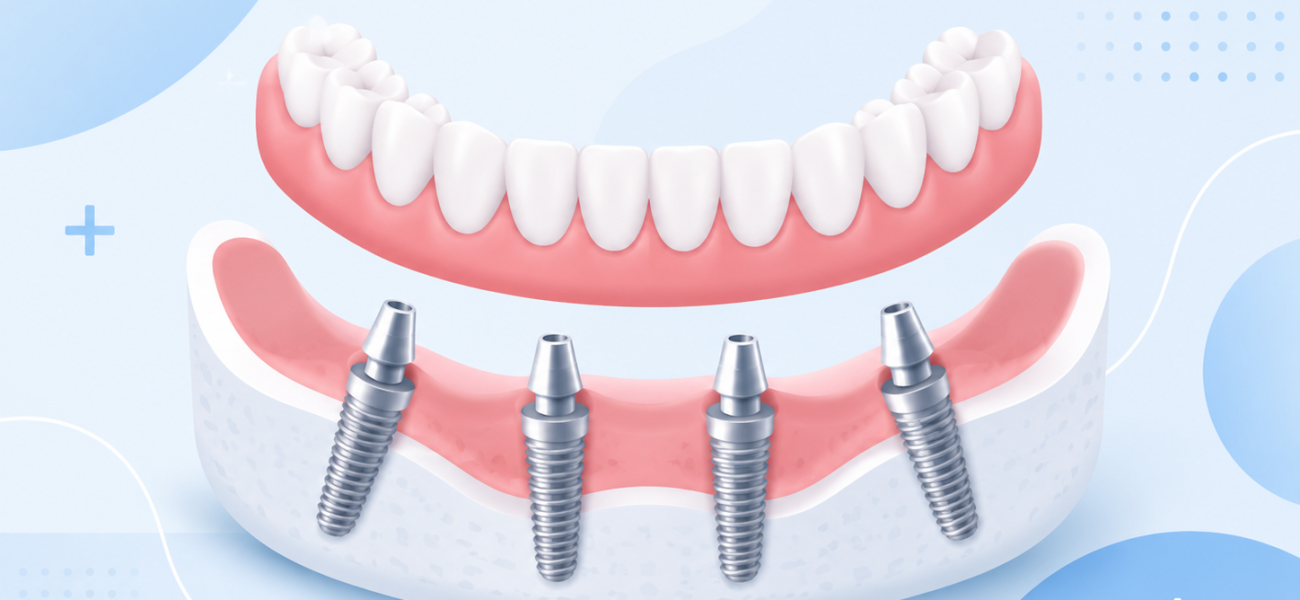

All-on-4 dental implants and traditional dental implants are both used to replace missing teeth, but they are designed for different situations.
All-on-4 replaces a complete upper or lower arch using four implants. Traditional implant treatment can replace one tooth, several teeth, or a full arch using a different number and arrangement of implants.
This guide compares the main differences in treatment purpose, cost, recovery, bone requirements, and long-term maintenance.
Quick Comparison
| Feature | All-on-4 | Traditional Dental Implants |
|---|---|---|
| Main purpose | Replaces a complete dental arch | Replaces one, several, or all missing teeth |
| Number of implants | Usually four per jaw | Varies according to the treatment plan |
| Common use | Extensive or full-arch tooth loss | Single, multiple, or full-arch tooth loss |
| Temporary teeth | Often fitted early in treatment | Timing varies |
| Healing period | Commonly 3–6 months | Commonly 3–6 months |
| Bone grafting | May be avoided in some cases | May be required more often in selected areas |
| Cost structure | Usually quoted per jaw | Often quoted per implant, crown, bridge, or full plan |
| Treatment flexibility | Primarily a full-arch solution | Suitable for small or extensive areas of tooth loss |
The appropriate option should be assessed after a dental examination and imaging. A consultation with a dentist can help clarify the condition of the remaining teeth, gums, bite, and jawbone.
What Are All-on-4 Dental Implants?
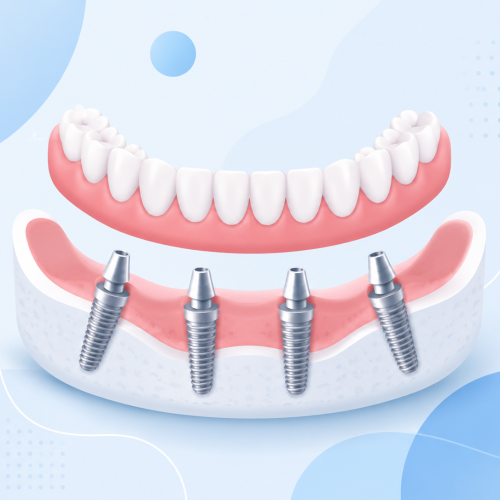
All-on-4 is a full-arch treatment in which four implants support a fixed set of replacement teeth in the upper or lower jaw.
It is commonly considered for patients who:
- Have lost most or all teeth in one jaw
- Have severely damaged or failing teeth
- Use loose or uncomfortable dentures
- Want a fixed alternative to removable teeth
- Require full-arch rehabilitation
The two implants at the back of the jaw may be placed at an angle to use the available bone more efficiently. This can reduce the need for additional procedures in some cases, although it does not remove the possibility of bone grafting for every patient.
Patients considering full-arch treatment may also want to compare All-on-4 vs All-on-6, as both approaches are designed to support a complete arch but use different numbers of implants.
What Are Traditional Dental Implants?
Traditional implant treatment is a broader category. It can be used to replace a single missing tooth, several teeth, or a complete arch.
A single missing tooth may be restored with an implant and crown. Several missing teeth may be replaced using an implant-supported bridge, while larger areas of tooth loss may require several implants or an implant-supported denture.
Traditional implant planning is generally more flexible because the number and position of implants can be adjusted to the area being treated.
Patients replacing only one or two teeth may also find a future comparison of single dental implants vs dental bridges useful when reviewing their available options.
Key Difference 1: Number of Missing Teeth
All-on-4 is mainly used when most or all teeth in one jaw are missing, damaged, or expected to be removed.
Traditional implants may be considered for:
- One missing tooth
- Several missing teeth
- Gaps in different parts of the mouth
- Implant-supported bridges
- Full-arch restorations
- Implant-supported removable teeth
A patient with one missing tooth would not normally require a four-implant full-arch restoration. A patient with extensive tooth loss may be assessed for All-on-4, All-on-6 dental implants, or another full-mouth treatment plan.
Key Difference 2: Number and Position of Implants
All-on-4 generally uses four implants per jaw.
Traditional implant treatment has no fixed number. The treatment may involve:
- One implant for one missing tooth
- Two implants supporting a short bridge
- Several implants supporting a larger restoration
- A customized implant arrangement for full-mouth treatment
The number of implants is influenced by jawbone volume, bite force, tooth position, prosthetic design, and the condition of the remaining teeth.
A 3D dental scan may be used to assess available bone and identify the position of nerves, sinuses, and other important structures before implant placement.
Key Difference 3: Treatment Cost
All-on-4 is usually priced as a full-arch package. Traditional implant treatment is more commonly priced according to the number of implants, abutments, crowns, bridges, or dentures required.
| Treatment Type | Common Pricing Method |
| Single traditional implant | Implant, abutment, and crown |
| Multiple traditional implants | Number of implants and bridge design |
| Full-mouth traditional implants | Customized full treatment plan |
| All-on-4 | Usually quoted per jaw |
| All-on-4 for both jaws | Usually quoted as a full-mouth package |
For full-arch tooth loss, All-on-4 may cost less than replacing each missing tooth with a separate implant. However, package prices should be checked carefully.
Patients should confirm whether the quote includes:
- Dental examination and imaging
- Tooth extractions
- Implant components
- Temporary teeth
- Final prosthesis
- Medication
- Anesthesia or sedation
- Follow-up visits
- Hotel and transfer services, if offered
A future guide covering what is included in a dental implant package could help patients identify costs that may be excluded from a headline price.
Key Difference 4: Temporary and Final Teeth
All-on-4 treatment commonly includes temporary fixed teeth during the healing period. These allow the patient to leave with a set of teeth after the surgical stage, but they are not usually the final prosthesis.
Traditional implant treatment may involve:
- A temporary crown
- A temporary bridge
- A removable temporary denture
- No temporary restoration in some cases
The final crown, bridge, or full-arch prosthesis is normally fitted after the implants have integrated with the jawbone.
Patients should always ask whether the advertised price includes both the temporary and final restorations.
Key Difference 5: Treatment Timeline
Both approaches usually include a surgical stage and a restorative stage.
After implant placement, the implants are generally left to integrate with the jawbone. This healing period commonly takes around three to six months, although bone grafting or more complex treatment may extend the process.
| Stage | All-on-4 | Traditional Implants |
| Consultation and imaging | Required | Required |
| Implant surgery | Four implants per jaw | Number varies |
| Temporary restoration | Often fitted early | Varies by treatment |
| Healing period | Usually 3–6 months | Usually 3–6 months |
| Final restoration | After healing | After healing |
| Number of visits | Commonly two stages | One or more stages |
Patients travelling abroad should allow for the possibility of a second visit for the final restoration.
Key Difference 6: Recovery
Early recovery after both treatments may involve swelling, soreness, bruising, and minor bleeding.
Recovery after one traditional implant may be more limited than recovery after full-arch surgery. All-on-4 treats a larger area and may involve extractions and four implant sites during the same stage.
A general dental implant recovery timeline may include:
| Time After Surgery | General Expectations |
| First 24–48 hours | Swelling, soreness, and rest |
| First week | Soft food and careful oral cleaning |
| 2–6 weeks | Gradual improvement |
| 3–6 months | Implant integration |
| After healing | Final restoration placement |
Dental surgery can cause pain, bleeding, and swelling during early recovery. Patients should follow the instructions provided by their treating dental team.
This is general information and not medical advice.
Key Difference 7: Bone Grafting
Implants require adequate bone support.
All-on-4 may reduce the need for bone grafting in some cases because the rear implants can be angled toward areas with more available bone.
Traditional implants may require grafting when a specific missing-tooth area has insufficient bone. This may be more likely when a tooth has been missing for a long time or when there has been significant bone loss.
However, All-on-4 does not guarantee that grafting will be unnecessary. The need for additional procedures can only be assessed after imaging and clinical examination.
Key Difference 8: Maintenance and Repairs
Both treatments require daily cleaning and professional follow-up.
All-on-4 supports one connected full-arch prosthesis. If the prosthesis chips, loosens, or requires adjustment, part or all of the arch may need to be removed for repair.
Traditional implants may support individual crowns or smaller bridges. Depending on the design, a problem may be limited to one crown or one section of the restoration.
Patients should ask:
- How should the implants be cleaned?
- Are special brushes or flossing tools needed?
- How often are check-ups recommended?
- Can the restoration be repaired in the home country?
- What happens if a crown or prosthesis fractures?
- Will an implant passport be provided?
A future article about how to care for dental implants could explain daily cleaning, professional maintenance, and long-term follow-up in more detail.
Which Option Is More Affordable?
For a single missing tooth, a traditional implant and crown will normally cost less than a complete All-on-4 restoration.
For full-arch tooth loss, All-on-4 may offer a more predictable package cost because four implants support the complete arch.
However, the lower initial quote is not always the lower total cost. Patients should compare:
- Temporary and final teeth
- Implant brand
- Prosthetic material
- Extractions
- Bone grafting
- Imaging
- Medication
- Return visits
- Repairs and maintenance
The most useful comparison is based on the complete treatment plan rather than the initial advertised price.
What Additional Medical Costs May Be Identified After Assessment?
The initial cost comparison between All-on-4 and traditional dental implants may change after clinical examination and 3D imaging.
| Possible Additional Medical Cost | How It May Affect the Treatment Plan |
|---|---|
| Additional dental imaging | May reveal insufficient bone, infection, nerve position, or sinus limitations |
| Tooth extraction | Remaining damaged or infected teeth may need to be removed |
| Surgical extraction | More complex teeth may require a surgical rather than routine extraction |
| Bone grafting | May be needed at one or more implant sites |
| Sinus lift | May be needed for implants planned in the upper back jaw |
| Periodontal treatment | Gum disease may need to be controlled before implant placement |
| Additional implants | The final number of implants may change after imaging and prosthetic planning |
| A different bridge or prosthesis design | The bite, available space, or implant distribution may require a revised restoration |
| Temporary restoration | A temporary crown, bridge, or denture may be charged separately |
| Sedation or general anesthesia | May be an additional medical cost when not included in the original plan |
Patients should compare the complete treatment plan rather than only the initial implant price. The final quote should identify the number of implants, required preliminary treatment, temporary restoration, and final prosthesis.
Who May Be Considered for All-on-4?
All-on-4 may be discussed for patients who:
- Are missing most or all teeth in one jaw
- Have several failing teeth
- Want fixed teeth rather than removable dentures
- Need a complete arch restored
- Have a treatment plan that can be supported by four implants
- Understand that final teeth may require a later visit
This does not mean All-on-4 is suitable for everyone. Suitability should be assessed by a licensed dental professional.
Who May Be Considered for Traditional Dental Implants?
Traditional implants may be discussed for patients who:
- Are missing one tooth
- Are missing several teeth
- Want individual tooth replacement
- Need an implant-supported bridge
- Have healthy remaining teeth that can be preserved
- Require a customized distribution of implants
- Do not need a complete full-arch restoration
Traditional implant treatment may be more appropriate when tooth loss affects only part of the mouth.
Risks and Limitations
Both All-on-4 and traditional implants involve surgery. Possible risks can include:
- Pain, swelling, or bruising
- Infection
- Implant failure
- Nerve-related symptoms
- Sinus-related complications in the upper jaw
- Bite problems
- Crown, bridge, or prosthesis damage
- Need for additional treatment
A future guide about dental implant failure could explain possible causes, warning signs, and questions patients should ask if an implant does not integrate properly.
Some chronic illnesses can interfere with healing, and tobacco use may also slow healing following implant surgery.
Patients should discuss their individual medical and dental history with licensed professionals before making treatment decisions.
Questions to Ask Before Choosing
Before deciding between All-on-4 and traditional implants, patients should ask:
- Why is this option being recommended?
- How many implants are planned?
- Is 3D imaging included?
- Are tooth extractions required?
- Is bone grafting needed?
- Are temporary teeth included?
- Are final teeth included?
- What material will the final restoration use?
- How long is the expected healing period?
- Is a second visit required?
- What happens if an implant fails?
- How will follow-up work after returning home?
International patients should also confirm that the healthcare provider or intermediary organization holds the required International Health Tourism Authorization Certificate.
Final Thoughts
All-on-4 and traditional dental implants can both replace missing teeth, but they serve different needs.
All-on-4 is mainly designed for complete arch replacement using four implants. Traditional implant treatment offers more flexibility for replacing one tooth, several teeth, or a complete arch using a customized number of implants.
MedicaRoute can help patients compare itemized treatment plans and understand which services are included before travelling. The aim should be to understand the complete procedure, recovery period, final restoration, and follow-up requirements rather than choosing only by price.