
FUE or DHI—which one should you choose?
The answer is less straightforward than many clinic advertisements suggest.
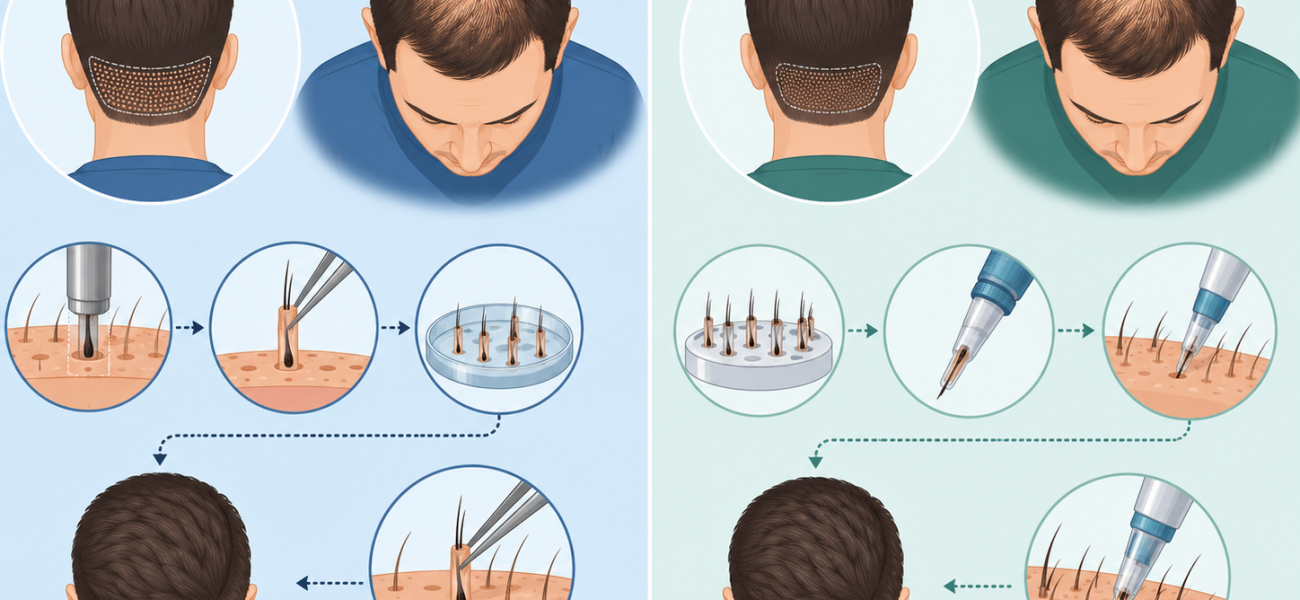
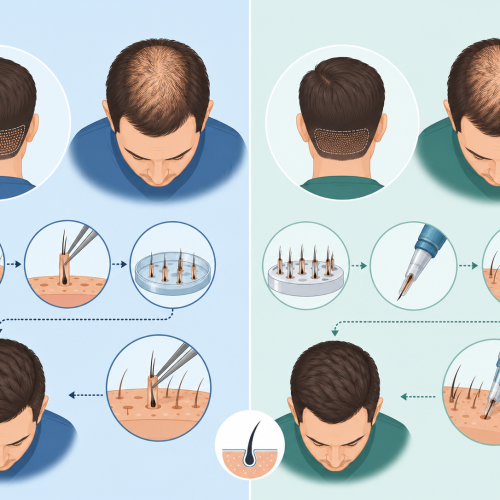
FUE hair transplantation describes how individual follicular units are removed from the donor area. DHI hair transplantation generally refers to placing those grafts into the recipient area with an implanter device.
In other words, many procedures marketed as “DHI” still use FUE to harvest the grafts.
The International Society of Hair Restoration Surgery explains that DHI is a term used for implantation with sharp implanters rather than a completely separate method of hair transplantation.
For patients, this changes the comparison. The important question is not simply “Is FUE or DHI better?” It is why a particular implantation approach is being recommended for your hair-loss pattern, donor area, existing hair, and planned number of grafts.
FUE vs DHI at a Glance
| Question | FUE-Based Hair Transplant | DHI / Implanter Placement |
| How are grafts removed? | Individual follicular units are harvested with FUE punches | Grafts are commonly harvested using FUE as well |
| How are grafts placed? | Recipient sites may be created first, followed by graft placement | Grafts are loaded into an implanter and inserted into the recipient area |
| Is it a completely different extraction method? | FUE is an extraction method | No. DHI generally describes implantation rather than donor harvesting |
| Does it always require shaving? | No; shaving strategy depends on the procedure | No; DHI does not automatically mean no-shave |
| Is one automatically denser? | No | No |
| Is one automatically more natural? | No | No |
| Which is better? | Depends on the treatment plan and surgical team | Depends on the treatment plan and surgical team |
When Might FUE Be Chosen?
With FUE, individual follicular units are harvested from the donor area using small punches. The extracted grafts are then implanted into the areas affected by hair loss.
In many FUE procedures, the surgeon first designs and creates recipient sites that determine important elements such as:
- Hair direction
- Angle
- Distribution
- Hairline design
- Planned density
The grafts are then placed into these sites.
This approach may make sense when the surgical team has extensive experience with recipient-site creation and graft placement and when the planned distribution can be efficiently achieved with that workflow.
FUE is also flexible. It can be used for frontal hairline restoration, larger areas of thinning, crown restoration, and selected corrective procedures.
The main reason to choose it should therefore not be that FUE is simply “cheaper” or “more traditional.” It should be that the surgeon believes their FUE-based harvesting and placement strategy is appropriate for the patient’s donor supply and recipient-area requirements.
When Might DHI Be Chosen?
In a DHI-style procedure, harvested follicular units are loaded into an implanter device.
With a sharp implanter, the device can create the recipient opening and insert the graft as part of the same placement step.
This may be useful when the surgeon wants precise control over individual graft placement or is working in an area where existing hairs need to be considered carefully.
For example, an implanter-based approach may be discussed when treating:
- Areas containing existing hair
- Localized thinning
- Frontal hairline areas
- Areas requiring careful control of graft direction and angle
However, these situations do not mean DHI is automatically superior.
Experienced surgeons can also create precise angles, natural hairlines, and appropriate density using other implantation techniques.
The reason for choosing DHI should therefore be based on the surgeon’s treatment plan—not simply because an implanter pen is marketed as newer technology.
The Most Important Difference: Implantation
One of the biggest sources of confusion is that FUE and DHI are often presented as two completely separate procedures.
They are not directly equivalent terms.
FUE primarily describes graft harvesting.
DHI primarily describes graft implantation using an implanter.
A patient may therefore have follicles extracted using FUE and then implanted using a DHI-style implanter technique.
That is why patients should ask clinics to describe both parts of the procedure:
- How will my grafts be harvested?
- How will my grafts be implanted?
A clinic that simply says “You need DHI” without explaining why the implantation method suits the individual treatment plan is not providing enough information.
Which Is Better for a Receding Hairline?
For a receding frontal hairline, either technique may be used.
What matters most is not whether the procedure is labelled FUE or DHI, but how the surgeon plans:
- Hairline height
- Hairline shape
- Single-hair graft placement
- Hair direction
- Hair angle
- Transition from the hairline into denser areas
- Future progression of hair loss
An implanter may provide the surgical team with a particular way of controlling graft placement, but it does not automatically create a more natural hairline.
Hairline design and execution remain critical.
Which Is Better If You Still Have Hair in the Recipient Area?
This is one situation where an implanter-based technique may be considered.
When hair is thinning rather than completely absent, grafts may need to be positioned between existing hairs. Some surgeons prefer implanters in these areas because they allow grafts to be inserted individually according to the planned direction and spacing.
However, existing hair also needs to be protected during any transplant.
The decision should consider:
- Amount of existing hair
- Degree of miniaturization
- Pattern of future hair loss
- Recipient-area space
- Planned graft density
- Surgeon experience
Simply having existing hair does not automatically make DHI necessary.
Which Is Better for a Large Number of Grafts?
There is no universal graft-count threshold at which FUE becomes better than DHI.
For larger sessions, some surgical teams may prefer creating recipient sites first and then placing grafts because this fits their workflow and allows efficient distribution across a larger area.
Other experienced teams may use implanters for substantial sessions.
Therefore, claims such as “DHI is only for small transplants” or “FUE is always better for large transplants” are too simplistic.
Instead, ask:
How many grafts are planned, how will they be distributed, and why is this implantation method being recommended for that number of grafts?
Does DHI Produce Higher Density?
Not automatically.
Final visual density depends on several factors:
- Available donor hair
- Number of viable grafts
- Hair shaft thickness
- Number of hairs within each follicular unit
- Recipient-area size
- Hair-to-skin colour contrast
- Hair characteristics
- Graft distribution
- Future hair loss
- Safe donor management
An implanter is a surgical instrument. It cannot create unlimited donor hair or guarantee higher density.
A proposal for very high density should therefore be evaluated in relation to the patient’s available donor supply and long-term hair-loss pattern.
Does DHI Look More Natural Than FUE?
Neither label guarantees a more natural result.
Natural-looking hair transplantation depends heavily on how the grafts are selected and positioned.
Important factors include:
- Hairline design
- Use of appropriate single-hair grafts at the front
- Direction of implantation
- Angle of implantation
- Density distribution
- Irregularity that resembles a natural hairline
- Matching the design to facial proportions
- Planning for future hair loss
A well-planned FUE procedure can look natural. A well-planned procedure using implanters can also look natural.
Poor planning can produce an unnatural result regardless of which technique is advertised.
Does DHI Mean You Do Not Have to Shave Your Hair?
No.
DHI and no-shave transplantation are not the same thing.
Whether the donor or recipient area needs to be shaved depends on the harvesting strategy, hair length, planned number of grafts, treatment area, and surgeon preference.
There are specifically designed non-shaven and long-hair FUE approaches, while some DHI procedures may also be performed with limited shaving.
Patients interested in keeping more of their existing hair length should ask whether unshaven DHI hair transplantation or another non-shaven approach is actually suitable for their case.
Is Recovery Faster With DHI?
Patients should be cautious about promises that DHI automatically produces significantly faster healing than FUE.
Both approaches involve removing and transplanting follicular units, creating multiple small wounds in the donor and recipient areas.
Early recovery can include:
- Redness
- Scabbing
- Mild swelling
- Tenderness
- Temporary numbness
- Temporary shedding of transplanted hair
Recovery can be influenced by the number of grafts, size of the treated area, harvesting technique, implantation technique, individual healing, and postoperative care.
For a detailed explanation of healing stages, temporary shedding, and hair growth after transplantation, read our Hair Transplant Recovery Timeline guide.
The choice between FUE and DHI should therefore not be based solely on advertisements promising a particular number of recovery days.
For a broader overview, see Hair Transplants in Turkey: Costs, Clinics & Recovery.
So, Which Should You Choose: FUE or DHI?
A useful way to think about the decision is:
FUE may make sense when:
- The surgeon recommends a conventional recipient-site and placement approach for your planned transplant
- A relatively broad recipient area needs to be covered
- The surgical team has strong experience with FUE harvesting and its preferred placement technique
- The treatment plan clearly explains graft numbers, distribution, hairline design, and donor management
DHI-style implantation may make sense when:
- The surgeon specifically wants to use an implanter for graft placement
- Grafts will be positioned among existing hairs
- A targeted recipient area requires careful individual placement
- The surgeon has substantial experience using implanters
- There is a clear clinical or technical reason for choosing the technique
These are planning considerations, not rigid rules.
A patient should not select DHI simply because it is described as “more advanced,” and should not select FUE simply because it costs less.
What Matters More Than FUE vs DHI?
For many patients, several factors are more important than the technique label itself.
Before deciding, confirm:
- Who evaluates your hair loss
- Who designs your hairline
- Who determines the number of grafts
- Who performs donor harvesting
- Who creates recipient sites
- Who implants the grafts
- How the donor area will be protected from overharvesting
- How future hair loss has been considered
- Whether your donor supply can realistically provide the proposed coverage
- What follow-up is available after returning home
The ISHRS emphasizes that FUE is a surgical procedure requiring medical judgment and skill, particularly during donor harvesting.
Technology and instruments matter, but they do not replace surgical planning and experience.
Comparing FUE and DHI Through MedicaRoute
MedicaRoute allows patients to compare available FUE hair transplant and DHI hair transplantation options rather than relying only on the technique name.
Related approaches also include Sapphire FUE hair transplantation and Hybrid FUE Sapphire and DHI hair transplantation.
When comparing providers, focus on the proposed graft number, donor-area assessment, hairline design, implantation method, who performs each surgical stage, follow-up arrangements, and the complete treatment quote.
Final Thoughts
The choice between FUE and DHI should not begin with the question, “Which technique is better?”
A better question is:
“Why is this technique better suited to my particular hair-loss pattern and treatment plan?”
FUE describes the individual harvesting of follicular units, while DHI generally refers to implanting grafts with an implanter device. The two can therefore be part of the same hair transplant procedure.
DHI may be considered when implanter-based placement offers practical advantages for the surgeon’s plan, including selected areas with existing hair or targeted graft placement. A conventional FUE-based approach may be preferred for other treatment patterns or surgical workflows.
Neither technique guarantees greater density, a more natural hairline, faster healing, or a better final result simply because of its name.
The stronger treatment plan is the one that clearly explains why the technique has been selected, how many grafts are realistically available, how the donor area will be protected, who will perform the critical surgical stages, and how the hair-loss pattern has been planned for over the long term.